> For the complete documentation index, see [llms.txt](https://doc.vapi.co/tr/llms.txt). Markdown versions of documentation pages are available by appending `.md` to page URLs; this page is available as [Markdown](https://doc.vapi.co/tr/en/getting-started/what-should-we-know-about-medications.md).
# What Should we Know About Medications ?
Before using vapi.co services, it can be useful to have some basic knowledge about pharmaceuticals and dietary supplements.
## What is drug ?
Drugs are substances developed in various forms and used in living organisms for the treatment or diagnosis of specific diseases, as preventive measures, or to control symptoms.
Drugs consist of an [**active ingredient** ](#etkilesim-drug-interaction)and [**excipients**](#yardimci-madde-excipient-inactive-ingredient).
## What is a Dietary Supplement?
Dietary supplements are products developed and used to provide the body with nutrients that cannot be consumed in sufficient quantities. These supplements may include nutrients such as vitamins, minerals, amino acids, and fatty acids.
## What are the Differences Between Drugs and Dietary Supplements?
\
Drugs are prescribed by physicians and are used for specific medical conditions [(indications)](#endikasyon-indication). They contain synthetic or natural active ingredients.
Dietary supplements are used independently of disease states to support healthy body functions and address nutritional deficiencies. They contain ingredients such as vitamins, minerals, amino acids, and herbal extracts.
## Terminology
### Drug-Related Terms
#### Etken Madde - Active Ingredient
The active ingredient is the chemical component responsible for the medicinal or therapeutic effects of a drug. It is known as the primary active substance of the medication.
*For example, the active ingredient of the drug Parol is paracetamol.*
A drug's active ingredient is the most critical component in its formulation, providing its therapeutic benefits. Because of this, it is prominently displayed on drug labels, and doctors, pharmacists, and healthcare professionals pay close attention to it when prescribing or dispensing medication.
#### Yardımcı Madde - Excipient (Inactive Ingredient)
In drug formulations, components that surround or carry the active ingredient are called "excipients" (or inactive ingredients). Excipients can enhance the stability of the drug formulation, facilitate absorption, improve physical properties such as taste or color, and make administration easier.
#### Endikasyon - Indication
Information specifying the conditions or diseases for which a drug or treatment should be used.
*For example: fever, headache, nausea, breast cancer...*
#### Kontrendikasyon - Contraindication
Information specifying the conditions or diseases in which a drug or treatment should **not** be used.
*For example, if a drug is stated to be contraindicated in flu infections, it must not be used in the presence of a flu infection.*
#### Doz - Dosage
Refers to the specified amount of a drug to be taken within a given period of time.
*For example, "3 times a day" is a dosage statement. It indicates that 3 units should be taken in a single day at equal intervals. On prescriptions, this is often expressed as "3x1".*
#### Yan Etki - Side Effect
Side effects are unwanted physiological or psychological reactions that can occur as a result of using a drug.
*For example: nausea, vomiting, diarrhea...*
Side effects are categorized based on their frequency of occurrence as follows: very common, common, uncommon, rare, very rare, and frequency unknown.
#### Kısa Ürün Bilgisi (KÜB) - Summery of Product Characteristics (SmPC)
The Summary of Product Characteristics (SmPC) is an official document containing essential information about a medication intended specifically for healthcare professionals.
It covers topics such as indications, posology (dosage and administration), contraindications, warnings, side effects, storage conditions, shelf life, and drug incompatibilities.
#### Kullanma Talimatı (KT) - Patient Information Leaflet (PIL)
The Patient Information Leaflet (PIL) is a document containing essential information intended for the person using the medication. Unlike the SmPC, it is addressed to the general public rather than healthcare professionals and is written in much simpler, accessible language.
It includes sections such as: what the drug is and what it is used for, what you need to know before taking it, how to take it, possible side effects, and how to store it.
#### Eşdeğer / Alternatif - Equivalent / Alternative Drugs
Drug equivalence is classified in several ways:
* **Pharmaceutical Equivalent:** A condition where two drugs have the same pharmaceutical form (tablets, capsules, etc.) and contain the same amount of the exact same active ingredient.
* **Bioequivalent:** A condition where two pharmaceutical equivalents demonstrate similar bioavailability and effects within specified limits after being administered at the same dose.
* **Therapeutic Equivalent:** A condition where two drugs containing the same active ingredient exhibit the same therapeutic efficacy and safety profile.
* **SGK Equivalent (Reimbursement Equivalent):** The equivalent designated by the Social Security Institution (SGK) for a drug covered under public reimbursement. It may not always match pharmaceutical equivalence criteria, as the classification is determined directly by SGK.
#### Jenerik / Orjinal İlaç - Generic / Original Drug
**Original Drug:** The innovative drug developed, patented, and brought to market by the patent-holding company. In the pharmaceutical industry, the standard patent protection period is 20 years.
**Generic Drug:** A bioequivalent alternative drug that comes to market after the original drug's patent expires, manufactured to meet specific regulatory standards.
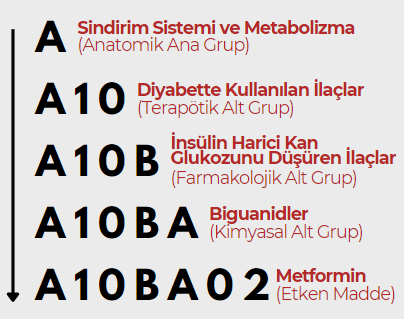
#### Anatomik Terapötik Sınıflandırma (ATC) - Anatomical Therapeutic Chemical Classification
A classification system created and maintained by the World Health Organization (WHO). It categorizes active ingredients according to the organ or system on which they act, as well as their therapeutic, pharmacological, and chemical properties.
Örnek ATC grubu
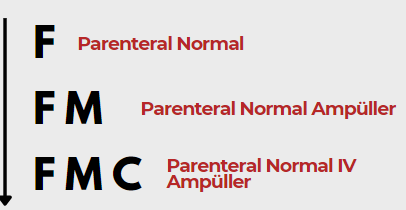
#### Yeni Form Kodu (New Form Code - NFC)
A classification system created and maintained by EphMRA (European Pharmaceutical Market Research Association) that categorizes drugs based on their pharmaceutical form.
Örnek NFC grubu
#### Gebelik Kategorisi - Pregnancy Category
Drugs are categorized into 5 groups to assess their safety profile during pregnancy:
**Category A:** Controlled studies in humans are available and have failed to demonstrate a risk to the fetus.
**Category B:** No controlled studies in humans; animal studies have failed to demonstrate a fetal risk.
**Category C:** No controlled studies in humans or animals, or animal studies have shown an adverse effect on the fetus, but there is no evidence of fetal risk in humans.
**Category D:** There is positive evidence of human fetal risk. Should only be used after evaluating the benefit-to-risk ratio.
**Category X:** Fetal risk is proven in both human and animal studies. Use in pregnant women carries high risk and is strictly [contraindicated](#kontrendikasyon-contraindication).
#### Aç / Tok Kullanım - Administration Relative to Meals (Before/After Meals)
Oral medications are categorized according to their timing relative to food intake.
These categories include on an empty stomach, on a full stomach, taken with meals, etc.
#### Uygulama Yolu - Route Of Administration
Drugs are introduced into the body through various pathways, which are referred to as routes of administration.
Examples of administration routes include oral, ear, eye, nose, intravenous, subcutaneous, and intramuscular. In the medical world, these routes are commonly referred to by their Latin or standardized terminology.
*For example: oral, otic, conjunctival, nasal, intravenous (IV), subcutaneous (SC), intramuscular (IM)...*
#### Farmasötik Form - Pharmaceutical Form
The pharmaceutical form defines the physical presentation of a medication. It is also referred to as the dosage form.
*For example: tablet, capsule, syrup, lotion, cream, ointment...*
#### Geçimsizlik - Incompatibility
Drugs can exhibit physical or chemical incompatibility when combined with certain other substances. Such medications must not be mixed together.
*For example, drugs containing the active ingredient ampicillin are incompatible with drugs containing active ingredients such as gentamicin or streptomycin. During administration, they should not be drawn into the same syringe or stored in the same container.*
#### Etkileşim - Drug Interaction
Interaction refers to the reactions that occur between medications (or other substances) after they are introduced into the body. As a result of these reactions, the efficacy of a drug may increase or decrease, or toxic reactions may occur. Drugs can interact with other drugs, foods, dietary supplements, disease conditions, or specific patient characteristics.
### İlaç Sektörüyle İlgili Terimler - Pharmaceutical Industry-Related Terms
#### Fiyat - Price
Each pharmaceutical product has several pricing tiers:
**Manufacturer Price:** The price at which the manufacturing company sells to wholesalers/distributors.
**Wholesaler Price:** The price at which wholesalers sell to pharmacies or hospitals.
**Pharmacy Price (Excl. VAT):** The selling price from the pharmacy, excluding Value Added Tax (VAT).
**Retail Price (Incl. VAT):** The final selling price at the pharmacy, including VAT.
**Public Price:** The reference price established for reimbursable drugs within the public healthcare system.
**Public Reimbursed Amount:** The actual portion of the drug price covered and paid by the Social Security Institution (SGK).
**Public Price Difference:** The out-of-pocket difference between the public price of a reimbursable drug and the amount paid by the SGK.
#### Barkod - Barcode
A unique 12 or 13-digit identification number used to distinguish products.
#### Firma - Company
Companies are divided into two categories: Marketing Authorization Holders (MAH) and Manufacturers. In most cases, the manufacturer and the marketing authorization holder are the same entity. However, in certain cases, a marketing authorization holder may contract another company to handle manufacturing.
#### Piyasa Durumu - Market Status
Market status refers to the availability of a drug or dietary supplement in the commercial market. It can be categorized into statuses such as Active, Not Manufactured / Not Imported, or License Cancelled / Suspended.
#### Geri Ödeme - Reimbursement
A portion of medications is reimbursed by the Social Security Institution (SGK). Whether a drug is covered under reimbursement and the specific amount to be reimbursed are determined by SGK.
#### SGK Kamu Numarası - SGK Public Code
The Social Security Institution (SGK) assigns a unique public code to provide distinct identification for all drugs covered under reimbursement.
#### SGK Eşdeğer Kodu - SGK Equivalent Code
A coding system created to group equivalent reimbursable drugs in accordance with Social Security Institution (SGK) rules.
*For example: E403C, H101A...*
#### SGK Etken Madde Kodu - SGK Active Ingredient Code
A coding system where the Social Security Institution (SGK) categorizes active ingredients based on specific rules (which may incorporate dosage, administration route, etc.) and assigns each a unique code. These codes are officially utilized in medical health reports.
*For example:*
**SGKEPL:** Albumin (human) 25%, Parenteral route
**SGKGCS:** Cabozantinib 140 mg, Oral route (Solid)
#### Sağlık Uygulama Tebliği (SUT) - Health Implementation Comnunique
An official regulatory communiqué that provides guidelines, pricing, regulations, and implementation details for the government's social health policies.
It specifies the conditions under which medications are reimbursed, as well as the criteria required for the validity of medical reports and prescriptions.
#### Reçete Türü - Prescription Type
In Turkey, medications can be prescribed under 7 different categories based on regulatory controls:
**White Prescription (Normal Prescription):** The standard prescription type used for the vast majority of non-controlled medications.
**Restricted White Prescription:** A type of prescription that must be issued by a medical specialist.
**Controlled Prescription (Subject to Control):** Prescriptions used for medications with a potential for misuse or abuse.
**Red Prescription:** A strictly monitored prescription type reserved for narcotic drugs.
**Green Prescription:** A monitored prescription type reserved for psychotropic substances.
**Purple Prescription:** A special prescription type designated for blood and blood product transfusions/treatments.
**Orange Prescription:** A special prescription type designated for blood clotting factors.
#### Soğuk Zincir - Cold Chain
A temperature-controlled supply chain that ensures temperature-sensitive products are consistently maintained within a specified temperature range from manufacturing through to patient administration.
#### Uluslararası Hastalık Sınıflandırması (ICD-10) Kodları -International Classification of Diseases (ICD-10) Codes
A disease classification system published and updated by the World Health Organization (WHO) and maintained globally (such as by the CDC in the US) to categorize diseases, symptoms, and clinical findings.
###